The Scoping Plan, Integration Analysis, New York Independent System Operator (NYISO), New York Department of Public Service, the New York State Reliability Council, and others all have noted that a new category of generating resources called Dispatchable Emissions-Free Resources (DEFR) is necessary to keep the lights on during periods of extended low wind and solar resource availability. The NYISO 2021-2040 System Resource Outlook states:
DEFRs that provide sustained on-demand power and system stability will be essential to meeting policy objectives while maintaining a reliable electric grid. While essential to the grid of the future, such DEFR technologies are not commercially viable today. DEFRs will require committed public and private investment in research and development efforts to identify the most efficient and cost-effective technologies with a view towards the development and eventual adoption of commercially viable resources. The development and construction lead times necessary for these technologies may extend beyond policy target dates.
In my opinion this requirement is the major reliability risk of the Climate Leadership & Community Protection Act (Climate Act) zero-emissions electric grid by 2040 target. DEFRs must be developed and deployed at scale well before 2040 to ensure reliability and meet climate mandates and are not commercially viable today. This page provides links to DEFR material.
Winter 2025-2026 Proof of the Need for DEFR
Two analyses of the extreme winter weather episdoe from January 23 – February 9 2026 found that DEFR was necessary: January 23-27 Winter Storm NY Grid Impacts Prove DEFR is Necessary and January February 2026 Winter Weather Proves the Need for DEFR
Compendium of DEFR Analyses
The following descriptions summarize seven analyses describing the need for DEFR: the Integration Analysis, NYISO 2023-2042 System & Resource Outlook, New York Department of Public Service (DPS) Proceeding 15-E-0302 Technical Conference, NYISO Power Trends, NYISO Resource Outlook, Richard Ellenbogen, Cornell Biology and Environmental Engineering, and Nuclear New York. I also include the Jacobson and Howarth work that forms the basis for those who believe that no new technology is needed.
NYISO Resource Outlook
The New York Independent System Operator 2023-2042 System & Resource Outlook (“Outlook”) Overview in Appendix F – Dispatchable Emission-Free Resources describes the reason DEFR is needed:
Numerous studies have shown that a system comprised of intermittent renewable energy resources and short-duration storage (i.e. 4 and 8-hour capacity duration) that cycle daily can economically meet demand in most hours across a year.
Appendix F in the Outlook evaluates three DEFR options that they believe represent the most likely viable approach but concede that there still are concerns even with these:
While DEFRs represent a broad range of potential options for future supply resources, two technology pathways being discussed as potential options for commercialization are: 1) utilization of low- or zero-carbon intensity hydrogen (typically generated by electrolysis derived from renewable generation) in new or retrofit combustion turbine or fuel cell applications or 2) advanced small modular nuclear reactors, which are currently seeking approval from the relevant regulatory bodies to design and operate these resources. Currently, both technologies have shown limited commercial viability on the proof of concept. Even assuming that they are commercially viable, there remains significant work in the implementation and logistics that must be overcome to economically justify transitioning the dispatchable fleet to some combination of new technologies in the next 15 years. Long-duration energy storage could potentially serve in the role of the modeled DEFRs in the Outlook. In many respects, long-duration energy storage closely mimics various hydrogen production and conversion pathways. Long-duration energy storage adds to load in many hours, similar to electrolysis production of hydrogen. However, a notable difference is that electrolysis production of hydrogen has a lower round-trip efficiency when injecting energy into the system compared to other long duration energy storage technologies under development.
The Resource Outlook provides projections for future generating resources, so it needs to include some technology options. To fulfil this need and consider the uncertainties, the Outlook “modeled several generic DEFRs to represent the range of potential capital and operating costs. In particular, the Low Capital/High Operating cost (LcHo) and High Capital/Low Operating cost (HcLo) DEFRs modeled in this Outlook are informed primarily by hydrogen and nuclear technologies, respectively.”
Appendix F provides some cost information. The following table extracts values from several figures for DEFR costs. The Outlook explains that “since DEFRs are a developing technology, the first units built will likely be more expensive compared to similar DEFRs built thereafter”. The Outlook used capital costs representing a mature deployment and “first-of-a-kind costs are not explicitly included as assumed cost components in this study”. As the Outlook points out this means that “the costs for DEFRs in this Outlook are likely to be below the actual costs of the first DEFRs built on the system”.
Integration Analysis
The Final Scoping Plan is the “official” Hochul Administration strategy description of the Climate Act transition. The Scoping Plan directly contradicts the statement that technologies available when the Howarth paper was written and today are sufficient for the transition away from fossil fuels. In particular, the Final Scoping Plan Appendix G, Section I page 49 states:
During a week with persistently low solar and wind generation, additional firm zero-carbon resources, beyond the contributions of existing nuclear, imports, and hydro, are needed to avoid a significant shortfall; Figure 34 demonstrates the system needs during this type of week. During the first day of this week, most of the short-duration battery storage is quickly depleted, and there are still several days in which wind and solar are not sufficient to meet demand. A zero-carbon firm resource becomes essential to maintaining system reliability during such instances. In the modeled pathways, the need for a firm zero-carbon resource is met with hydrogen-based resources; ultimately, this system need could be met by a number of different emerging technologies.

The analysis also recommends technologies for this resource:
Hydrogen effectively provides a form of storage to the system on the order of hundreds of hours. Large quantities of fuel can be produced during the spring and summer and then utilized over the course of the winter provided that there is sufficient fuel storage. In addition to hydrogen-based resources, the analysis also examined the potential to meet reliability needs with a long-duration battery storage solution. In this assessment, the firm zero-carbon capacity, as well as renewable resources needed to produce hydrogen, were removed from the system, and the analysis identified a need for 25 GW of 100-hour battery storage to replace the contributions of 21 GW of a fully dispatchable hydrogen-based resource, along with 14 GW of incremental renewable resources to provide storage charging.40 A 100-hour battery resource can provide firm capacity to meet system needs over several days. However, in contrast to a hydrogen-based resource, if sufficient excess energy is not available to fully recharge the batteries following a challenging stretch, their ability to meet a similar system need in subsequent weeks of the winter is diminished. As a result, a higher amount of 100-hour battery capacity is needed to meet the same level of reliability as hydrogen-based resources.
At the Zero Emissions by 2040 Technical Conference session Gap Characterization Kevin Steinberger, Director, Energy and Environmental Economics (E3) stated that their modeling consistently showed the need for a new resource that is firm, dispatchable, and has no emissions that can power the system for days without significant recharge from wind and solar resources.
NYISO Resource Outlook
In all the resource analyses prepared by the New York Independent System Operator (NYISO) since Climate Act implementation began, the necessity of DEFR has been mentioned. In the spring of 2024 the Power Trends 2024 report notes:
Renewable energy generation, subject to sudden changes in weather, also provides new challenges to grid operators that must balance supply and demand in real time. These variables highlight the need for new generation technologies that can fill in when weather-dependent resources are unavailable. Such new technologies, collectively referred to as Dispatchable Emission Free Resources (DEFRs), must be dispatchable, emissions free, and able to respond quickly to changing grid conditions. Such technologies do not exist yet on a commercial scale.
The NYISO described this resource in the 2021-2040 System & Resource Outlook:
DEFRs are a classification of emission- free resources that provide the reliability attributes of synchronous generation and can be dispatched to provide both energy and capacity over long durations. DEFRs must be developed and added to the system at scale to reliably serve demand when intermittent generation is unavailable. The lead time necessary for research, development, permitting, and construction of DEFR supply will require action well in advance of 2040 if state policy mandates under the CLCPA are to be achieved.
More recently, I described the Appendix F – Dispatchable Emission-Free Resources in the New York Independent System Operator 2023-2042 System & Resource Outlook. The Overview includes this summary:
Numerous studies have shown that a system comprised of intermittent renewable energy resources and short-duration storage (i.e. 4 and 8-hour capacity duration) that cycle daily can economically meet demand in most hours across a year.
However, due to the seasonal mismatch in electricity demand and weather dependent production from wind and solar resources, there remains a significant amount of energy that must be shifted from the low net load intervals of the spring and fall seasons to the peak load times during the summer and winter months, as discussed in Appendix E: Renewable Profiles and Variability.
I described Appendix E previously. The data presented in Appendix E show that there are frequent periods when all the wind and solar resources are expected to provide much lower output than their rated capacity. Initial results show that there was a 36-hour period when land-based wind, offshore wind, and solar resources were each less than 10% of their rated capacity. At the September 27, 2024 New York State Reliability Council (NYSRC) Extreme Weather Working Group (EWWG) meeting, Thomas Primrose from PSEG Long Island presented a refined analysis of these data. Among other things, his evaluation found that when New York solar, onshore wind, and offshore wind capacity were averaged the perio meeting the less than 10% criterion doubled to a 73 hour period. For context consider that. I found that if the renewable resources projected in the Integration Analysis, without any fossil-fired resources, were operating over those 73 hours that there would have been a cumulative generation deficit of up to 103,465 MWh within the lull. Note that the lull deficiency projection length is dependent upon the location of the solar and wind facilities, so this is an approximation. Nonetheless, it exemplifies the challenge that DEFR must resolve
I have also described the presentation by Zachary Smith that gave an overview summary presentation of the DEFR issue. In his first slide (shown below) he gave an overview of the generating resource outlook to make the point that a large amount of new generating resources needs to be developed. The estimates shown are from the 2021-2040 System & Resource Outlook and represent two plausible load projections. He noted that there are “a lot of attributes that fossil fuel resources provide today that wind, solar, and energy storage simply cannot provide”. He also made the point that the DEFR replacements do not have to be a single technology but could be several technologies that in aggregate can replace the fossil generation.

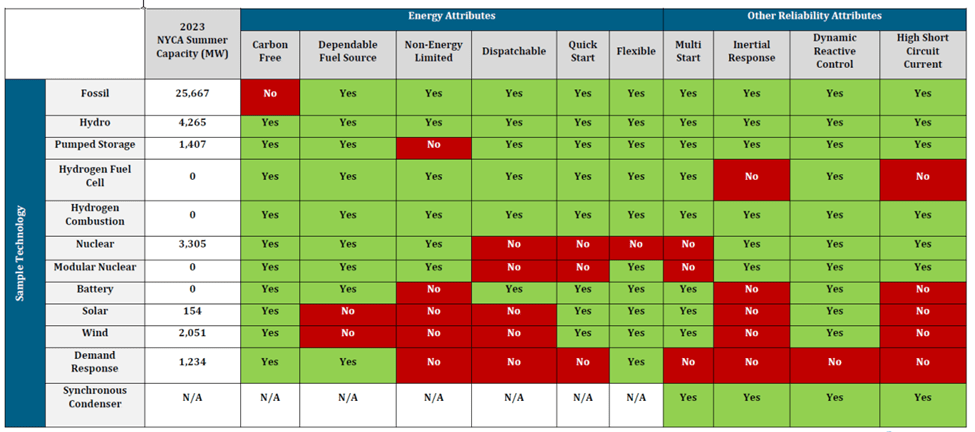
Smith listed the attributes needed by DEFR in his presentation. In my description of his discussion I offered comments on this list of attributes.

Smith’s presentation lists the attributes of twelve sample technologies in the following slide. This represents the NYISO opinion of the capability of different technologies to meet the attributes necessary to maintain a reliable system. In the future grid the insistence that all fossil fired units must be shut down means that numerous technologies that meet some of the necessary attributes will be required. The added complexity of these technologies does not increase resiliency because wind, solar, battery and demand response are all energy limited. Ancillary support services will be a major consideration because wind, solar and battery do not provide those services. Just from this overview, it is clear that affordability and reliability will be challenges.
Attributes of Sample DEFR Technologies
Richard Ellenbogen
I described Richard Ellenbogen’s comments as part of the record for the Department of Public Service Proceeding 15-E-0302 related to the net -zero mandate of the Climate Leadership and Community Protection Act (CLCPA). His comments discuss “a viable, affordable, and rapidly executable Plan B to assist NY State in reducing its carbon footprint using technologies that actually exist at scale, unlike the technologies proposed by the CLCPA which only exist at scale in the fantasies of its proponents.”
Ellenbogen lays out reasons that things have changed as the Climate Act is implemented that could affect the schedule and viability of the Scoping Plan list of control strategies. He concludes that an alternative that does not go to zero provides a better solution. He argues that Interim Combined Cycle Natural Gas Generation phasing to nuclear over time is a far more cost effective and secure way to power the state than what the CLCPA is mandating. Recovering the Combined Cycle emissions in greenhouses will mitigate the negative effect of the carbon emissions. That will also provide energy security that renewables can’t, while simultaneously providing food security as climate change makes food production more challenging.
Cornell Biology and Environmental Engineering
In a post describing the Zero Emissions by 2040 Technical Conference session Gap Characterization I summarized work by Prof. C. Lindsay Anderson, Chair of Department of Biological and Environmental Engineering Cornell. Professor Anderson described an analysis her group did using a model they developed and described here. Tim Knauss at the Syracuse Post Standard wrote a very readable description of this work.
They made projections for expected loads and potential resources then used 22 years of hourly historical data to model the system. Without considering cost constraints they assessed system vulnerabilities to evaluate periods where there was insufficient generation to meet projected loads. Even with optimistic projections they found there will be periods during the coldest and hottest periods where there will be insufficient generation from wind, solar, and energy storage resources. That gap must be filled with DEFR. Knauss explains that Anderson’s work estimated how much DEFR is needed:
A staggering amount, it turns out.
Just 15 years from now, the electric grid will need about 40 gigawatts of new generating capacity that can be activated regardless of wind speeds, cloud cover or other weather conditions, according to Anderson’s research.
How much is that? It’s roughly equal to the total capacity of all of New York’s current power plants – nuclear, natural gas, hydro, wind, all of it.
You read that right. To back up the massive quantities of solar and wind power that will provide most of our future electricity, the state power grid will need some new, mystery resource equal in size to the entire generating fleet of today.
Nuclear New York
I described the independent analysis of the future grid found that New York State has seriously underestimated the need for DEFR. The Filling the Gap in New York’s Decarbonization Plan: A New View of the Electric Grid report was authored by Leonard Rodberg, PhD, Research Director, Nuclear New York, Inc.; Consultant, Energy Policy; Reiner Kuhr, Founder, Center for Academic Collaborative Initiatives (CAIC); and Ahmad Nofal, Co-founder, CAIC.
The report describes the results of a new modeling tool that allows an hour-by-hour analysis of electric system behavior. This approach enabled the authors to see details of the hourly operation of each energy source, features not disclosed by existing models. In my opinion, the CAIC analysis treats DEFR differently than the Integration Analysis does. I believe that when the Integration Analysis determines which resources should be applied to meet load for each hour, they use DEFR as a last resort. On the other hand, CAIC uses DEFR much more frequently. That could be due to a difference in the hourly projections of wind, solar, energy storage, and load for the two models or presumptions in the models.
They found that:
Our hour-by-hour analysis shows that the firm dispatchable source has to run two-thirds of the year. The total load has increased from today. The summer peak has been replaced by a much higher winter peak. That greater demand is met by the extended operation of the DEFR which runs during most evenings in the cooler portion of the year. In fact, we find a capacity factor — the fraction of potential output actually used –of 14.4%.
The report concludes:
We have shown, with a modeling tool capable of performing an hour-by-hour analysis, that dispatchable emission-free resources are essential to meeting the goal of a reliable, zero-emission grid. Further, this clean dispatchable source must be able to run a large portion of the year. The only such source likely to be available within the next several decades is nuclear power.
DEFR is not Required
When the Climate Action Council voted to accept the Scoping Plan draft, council members made statements justifying their positions. The statement of Robert W. Howarth, Ph.D., the David R. Atkinson Professor of Ecology & Environmental Biology at Cornell University argued that no new technologies are needed and was uncritically accepted by some members of the Council. Importantly, the leadership of the Council did not object to the following:
A decade ago, Jacobson, I and others laid out a specific plan for New York (Jacobson et al. 2013). In that peer-reviewed analysis, we demonstrated that our State could rapidly move away from fossil fuels and instead be fueled completely by the power of the wind, the sun, and hydro. We further demonstrated that it could be done completely with technologies available at that time (a decade ago), that it could be cost effective, that it would be hugely beneficial for public health and energy security, and that it would stimulate a large increase in well-paying jobs. I have seen nothing in the past decade that would dissuade me from pushing for the same path forward.
This is the reason I am compiling DEFR analyses because it simply is not consistent with any of the organizations accountable for New York energy policy. The basis of the no new technology claim is the “Wind, Water, and Solar” work of Professor Mark Jacobson of Stanford. In my summary of this belief, I showed that Howarth’s argument that no new technology is needed has been refuted in the peer reviewed literature. In the remainder of this article I describe six other analyses that conclude that DEFR is required.
The Jacobson approach wass described in a widely publicized November 2009 Scientific American article by Mark Jacobson and Mark Delucchi that suggested all electrical generation and ground transportation internationally could be supplied by wind, water and solar resources as early as 2030. However, other contemporary projections were less optimistic, for example two examples disagreed: the 2015 MIT Energy and Climate Outlook has low carbon sources worldwide as only 25% of primary energy by 2050, and renewables only 16% and the International Energy Agency’s two-degree scenario has renewables, including biomass, as less than 50%.
Howarth’s statement cites a specific plan for New York (Jacobson et al. 2013) that he and Jacobson laid out a decade ago. He says that “In that peer- reviewed analysis, we demonstrated that our State could rapidly move away from fossil fuels and instead be fueled completely by the power of the wind, the sun, and hydro.” There was a formal rebuttal paper to this analysis by Nathaniel Gilbraith, Paulina Jaramillo, Fan Tong, and Felipe Faria. The rebuttal paper argued that:
The feasibility analysis performed by Jacobson et al. (2013) is incomplete and scientifically questionable from both the technical and economic perspectives, and it implicitly assumes, without sufficient justification, that social criterion would not produce even larger feasibility barriers.
Jacobson et al. responded to that rebuttal claiming that “The main limitations are social and political, not technical or economic.” Given the significant differences between that analysis and the most recent projections by the organizations responsible for keeping the lights on, I agree with the Gilbraith et al. conclusion cited above. I do not believe that the 2013 WWS analysis includes a defensible feasibility analysis proving that a dispatchable, emissions free resource is not needed during extended periods of low wind and solar resource availability.
Three books include analyses that also refute the Jacobson work. Meredith Angwin’s 2020 book Shorting the Grid: The Hidden Fragility of Our Electric Grid cites academic work rebutting the Jacobson premise. Angwin also describes two other books that directly refute it. Roadmap to Nowhere: The Myth of Powering the Nation With Renewable Energy by Mike Conley and Tim Maloney is available as a free PDF download on the web. Mathijs Beckers, of the Netherlands, wrote The Non-Solutions Project, available as an ebook or paperback.
I conclude that the basis for the influential position that no new technology is needed is not supported by the Jacobson work. More importantly, the previous analyses all conclude new technology is needed.
Potential DEFR Technologies
I summarized key points of the paper Getting to 100%: Six strategies for the challenging last 10% that described six potential ways to deal with peak load intermittency which are all potential DEFR strategies.
I believe that the laws of physics are a fundamental challenge for any DEFR technology as documented in my comment on renewable energy systems and the second law of thermodynamics.
Long duration storage is one strategy but there are issues: The Energy Storage Conundrum
The Draft Scoping Plan placeholder strategy for DEFR is hydrogen but there are issues:
- Pragmatic Environmentalist of New York Hydrogen Economy Issues Page
- Hydrogen as an Alternative to Batteries
Related Reliability Issues
I have written that the Climate Action Council has not confronted reliability issues raised by New York agencies responsible for keeping the lights on. The first post (New York Climate Act: Is Anyone Listening to the Experts?) described the NYISO 2021-2030 Comprehensive Reliability Plan (CRP) report (appendices) released late last year and the difficulties raised in the report are large. The second post (New York Climate Act: What the Experts are Saying Now) highlighted results shown in a draft presentation for the 2021-2040 System & Resource Outlook that all but admitted meeting the net-zero goals of the Climate Act are impossible on the mandated schedule. Recently I wrote about the “For discussion purposes only” draft of the 2021-2040 System & Resource Outlook report described in the previous article and the concerns raised. I compared the NYISO Resource Outlook and Draft Scoping Plan Generating Resource Projections and argued that they needed to be reconciled. At the October 25, 2022 Climate Action Council meeting (presentation and recording) Carl Mas described the differences between the NYISO resource projections and his Integration Analysis projections and I wrote about that here.
Pragmatic Environmentalist of New York Reliability-Related Comments on the Climate Act
Caiazza Personal Comment on Renewable Energy Resource Availability 11 March 2022
This comment explains why an accurate and detailed evaluation of renewable energy resource availability is crucial to determine the generation and energy storage requirements of the future New York electrical system. I describe the history of blackouts in New York and specific lessons from Texas that must be incorporated into New York planning to prevent a similar problem in New York. I explain that in order to ensure electric system reliability for an energy system that depends on renewable generators and energy storage, the resources available during periods of low wind and solar energy production must be known.
Caiazza Comment on Hydrogen as a Zero-Carbon Firm Resource June 23, 2022
This comment addresses the use of hydrogen in some form or other as the Draft Scoping Plan placeholder technology for the Zero-Carbon Firm Resource or Dispatchable Emissions-Free Resource (DEFR) generally accepted as a complementary requirement when intermittent resources like wind and solar make up a significant portion of the electric grid resource mix.
Caiazza Electric System Comments June 30, 2022
These comments address a few Draft Scoping Plan electric system issues. The ultimate problem is that the Climate Act presumed that converting the electric grid from its current reliance on fossil fuels to provide reliable electricity when needed most was just a matter of political will. The presentation addressed many of the comments included in this submittal.
Caiazza Comment Renewable Energy Systems and the Second Law of Thermodynamics July 1, 2022
The Integration Analysis and the Draft Scoping Plan zero-emissions electric grid transition plan depend on a long-duration, dispatchable, and emission-free resource that does not exist. This comment explains why there are reasons to believe that a commercially viable and affordable resource like this may never be developed.
New York Public Service Commission Finally Addresses Dispatchable Emissions-Free Resources May 22, 2023
The PSC announced a proceeding to address DEFR on May 18, 2023. This post describes the proceeding.
New York Focus – New York to Explore Non-Renewable Energy May 24, 2023
This post describes an article about the PSC proceeding.
January 23-27 Winter Storm NY Grid Impacts Prove DEFR is Necessary February 17, 2026
This post shows that DEFR is necessary to keep the lights on if a winter storm similar the Janiary 2026 storm occurs when wind and solar capacities necessary to achieve the 2040 zero emissions are in place.
Resource Gap
The NYISO 2023-2042 System & Resource Outlook summarizes the need for DEFR:
Numerous studies have shown that a system comprised of intermittent renewable energy resources and short-duration storage (i.e. 4 and 8-hour capacity duration) that cycle daily can economically meet demand in most hours across a year. However, due to the seasonal mismatch in electricity demand and weather dependent production from wind and solar resources, there remains a significant amount of energy that must be shifted from the low net load intervals of the spring and fall seasons to the peak load times during the summer and winter months. Advances in technological, economic, and modeling approaches are needed to better quantify and characterize the seasonal energy gap that remains to be served after the coordinated economic dispatch of renewables and storage resources. The NYISO seeks to improve the representation of this fleet segment in each of its successive studies, while understanding that characterization of emerging technology implementation pathways can introduce its own uncertainty into the model. The NYISO continues to recognize that there is a need for supply beyond renewables and storage resources that can provide dependability supply during the summer and winter peak periods and when the output of renewable resources is low.
There are problems defining the renewable resource gap Complication for Assessment of Extreme Renewable Resource Lulls April 12, 2025
To sum up: we know that DEFR will be needed, we don’t know how much, what it will be, how much it will cost, and that whatever we do eventually it won’t be enough so people will die in a catastrophic blackout.
 New York Energy Policies